Across Our State
At Inclusive TEAMS, we are committed to providing comprehensive resources that support both the professional development of future social workers and the well-being of the communities they serve. The resources in this section offer essential tools to address the behavioral health needs of BIPOC and LGBTQIA+ youth and families, from immediate crisis support to evidence-based research and educational materials. Additionally, we highlight the practicum agencies where our students are gaining hands-on experience, furthering their ability to provide culturally responsive care. These resources are designed to empower both students and community members, promoting effective, inclusive care and ongoing learning in the field of social work.
Partner Agencies
We are proud to partner with the following agencies to offer direct practice social work practicum placements for our Inclusive TEAMS students. Each of the following organizations have hosted or currently hosts a UNC-Chapel Hill School of Social Work student in the specialization year of their Masters program. All of the organizations offer services to underserved communities, including BIPOC and/or LGBTQIA+ youth, adolescents, and families by addressing critical behavioral health needs in a culturally responsive manner.
Crisis Resources
At Inclusive TEAMS, we are deeply committed to supporting the mental health and well-being of BIPOC and LGBTQIA+ youth and families across North Carolina. In addition to our work in training future social workers to provide culturally responsive care, we recognize the urgent need for accessible, immediate support for individuals facing mental health crises. Understanding that crises can occur at any time, and that timely intervention is crucial, we are providing this list of trusted crisis resources to ensure that help is always within reach. Whether through hotlines, text services, or local emergency support, these resources are designed to offer immediate assistance and connect individuals with trained professionals who can provide the care they need. By sharing these resources, we aim to reduce barriers to mental health care, create a safety net for those in need, and empower our communities to take proactive steps toward safety and healing.
The 988 Suicide & Crisis Lifeline provides free and confidential emotional support to people in suicidal crisis or emotional distress 24 hours a day, 7 days a week, across the United States and its territories. The 988 Lifeline is comprised of a national network of over 200 local crisis centers, combining local care and resources with national standards and best practices.
People do not have to be suicidal to call. Reasons to call include: substance use disorder, economic worries, relationships, culture and identity, illness, intimate partner violence, depression, mental and physical illness, and loneliness.
Call: 988
Text: 988
Chat
988 Lifeline ofrece servicios gratuitos en español 24/7, y no es necesario hablar inglés si necesita ayuda.
Llame 988
Text Envía “AYUDA” al 988
Chatea Con 988 Lifeline
LGBTQI+ people under 25 can access 24/7/365 LGBTQI+ support via 988 chat or by text by typing PRIDE. You will be asked if you want to opt-in to this support before you are connected to a counselor. People can also call 988 and press 3 to be connected to LGBTQI+ services.
Deaf and Hard of Hearing people have 24/7/365 access to 988 Videophone, which can be accessed by clicking on ASL Now. For TTY Users: Use your preferred relay service or dial 711 then 988.
Veterans, active service members, and their loved ones can reach the Veterans Crisis Line (VCL) 24/7/365 by calling 988 and pressing 1, texting 838255 or chatting via VCL.
Substance Abuse and Mental Health Services Administration – SAMSHA
The Substance Abuse and Mental Health Services Administration (SAMHSA) is a U.S. government agency dedicated to improving the nation’s health by promoting prevention, treatment, and recovery for substance use and mental health disorders. SAMHSA provides resources, guidance, and support to individuals, families, and communities, aiming to enhance access to care and reduce stigma associated with these issues. Their website offers a wealth of information, including educational materials, funding opportunities, and tools for those seeking help or wanting to support others in their recovery journey.
SAMHSA’s National Helpline is a confidential, free, 24-hour-a-day, 365-day-a-year, information service, in English and Spanish, for individuals and family members facing mental and/or substance use disorders. This service provides referrals to local treatment facilities, support groups, and community-based organizations
Call 1-800-662-HELP (4357)
TTY: 1-800-487-4889
Suicide Prevention Resource Center
The Suicide Prevention Resource Center (SPRC) is a national resource dedicated to advancing the prevention of suicide and promoting mental health. SPRC provides training, resources, and tools for professionals, organizations, and communities to implement effective suicide prevention strategies. The website features research, best practices, and guidance on creating supportive environments, raising awareness, and fostering resilience.
UNC Suicide Prevention Institute
The UNC Suicide Prevention Institute is dedicated to advancing research and initiatives aimed at preventing suicide and enhancing mental health. Based at the University of North Carolina’s Department of Psychiatry, the institute focuses on evidence-based practices, community engagement, and policy advocacy to reduce suicide risk. Their website offers information about ongoing research programs, resources for mental health professionals, and educational materials to raise awareness and support suicide prevention efforts.Visit the SPI Resources Page to view resources for crisis help.
Research & Education
At Inclusive TEAMS, we are committed to advancing the field of social work by equipping future practitioners with the tools and knowledge to address the unique needs of BIPOC and LGBTQIA+ youth and families. Our approach is informed by a strong foundation of research, which underscores the importance of culturally responsive care in reducing disparities in mental health diagnosis, treatment, and outcomes for these populations. On this page, you will find a curated collection of research articles and educational materials that highlight the critical need for specialized training in working with marginalized communities. These resources are designed to deepen understanding, enhance cultural competence, and guide the development of effective, identity-affirming practices for professionals engaged in behavioral health and social work. We hope these materials will support ongoing learning and promote best practices in the field as we continue to address the evolving needs of diverse populations.
Research Articles
Castro-Ramirez, F., Al-Suwaidi, M., Garcia, P., Rankin, O., Ricard, J. R., & Nock, M. K. (2021). Racism and poverty are barriers to the treatment of youth mental health concerns. Journal of Clinical Child & Adolescent Psychology, 50(4), 534-546. https://doi.org/10.1080/15374416.2021.1941058
Abstract
Objective: Traditional studies of treatment moderators have focused largely on psychological factors such as clinical severity. Racial and economic inequity exert large effects on youth mental health, on treatment efficacy, and on the likelihood of receiving treatment altogether. Yet, these factors are studied less often by clinical psychological scientists. Method: We conducted a narrative review of literature on racial and economic inequities and their impact on youth mental health. Results: First, systemic problems such as racism and poverty increase the risk of developing complex health issues and decrease the likelihood of benefiting from treatment. Second, attitudinal barriers, such as mistrust associated with treatments provided by researchers and government agencies, decrease the likelihood that minoritized groups will engage with or benefit from evidence-based treatments. Third, minoritized and underserved communities are especially unlikely to receive evidence-based treatment. Conclusion: Clinical psychological science has unique insights that can help address systemic inequities that can decrease treatment efficacy for youth mental health treatment. Psychological scientists can help eliminate disparities in accessing evidence-based treatment and help end violent policies in underserved minoritized communities by at the very least (1) building and supporting scalable community-based treatments as well as (2) publicly advocating for an end to violent policies that impose negative social costs.
Retrum, J. (2024). Improved student outcomes: A unique, culturally relevant, and intensive behavioral health training program. Social Work in Mental Health, 22(5), 605-622. https://doi.org/10.1080/15332985.2024.2354678
Abstract
The behavioral health workforce shortage is pervasive across the United States. To address this need, it is important to establish effective and culturally relevant trainings for behavioral health practitioners. This study examines the results of a Health Resource Service Administration (HRSA) Behavioral Health Workforce Education and Training (BHWET) funded program intended to increase the qualified workforce meeting high need and demand. Over the four-year funding of the program, 119 Masters of Social Work students graduated from the social work program with specialized training. The program was successful providing innovative training focused on interdisciplinary collaboration, evidence-based practices, and culturally responsive services.
Darnel, L., Bassett, D. M., Greathouse, T., Ryder, S., Starr, E., Knechtel, L., Atkinson, K., & Finlay-Jones, A., Strauss, P., Perry, Y., Waters, Z., Gilbey, D., Windred, M., Murdoch, A., Pugh, C., Ohan, J. L., & Lin, A. (2021). Group mindful self-compassion training to improve mental health outcomes for LGBTQIA+ young adults: Rationale and protocol for a randomized controlled trial. Contemporary Clinical Trials, 102. https://doi.org/10.1016/j.cct.2021.106268
Abstract
Background: Young adults who are lesbian, gay, bisexual, trans, queer or questioning, intersex, asexual and other diverse genders and sexualities (LGBTQIA+) are more likely to experience mental health difficulties and are at significantly elevated risk of substance abuse, self-harm and suicide, relative to their heterosexual, endosex and cisgender peers. There is a need for effective mental health interventions for LGBTQIA+ young adults. Mindful Self-Compassion training is a promising approach; among LGBTQIA+ individuals, self-compassion accounts for more variation in mental health outcomes than bullying, victimization, and adverse childhood experiences combined. Furthermore, LGBTQIA+ individuals with high self-compassion report more positive identity and happiness, less self-stigma, and lower suicidality than those with low self-compassion. Method: This paper outlines the rationale and protocol for a single-blind CONSORT-compliant randomised controlled trial, comparing group Mindful Self-Compassion to a delayed-treatment waitlist control group, for improving mental health, decreasing self-criticism and increasing self-compassion in LGBTQIA+ young adults (age 18–25 years). Mindful Self-Compassion training is an 8-week group program that focuses on cultivating self-compassion and mindfulness. While typically delivered as a face-to-face program, the proposed trial will investigate efficacy of the program when provided via videoconferencing. Discussion: Videoconference Mindful Self-Compassion training has the potential to improve the mental health of Australian LGBTQIA+ young adults and provide a possible cost-effective, scalable intervention for this population. The proposed trial will be the first to determine its efficacy for LGBTQIA+ young adults and will provide the first data on the delivery of the program via videoconferencing.
Halgunseth, L. C., Witherspoon, D. P., & Wray-Lake, L. (2022). Dismantling systems and improving contexts to support the development of BIPOC youth. Journal of Research on Adolescence, 32(2), 386-397. http://doi.org/10.1111/jora12773
Abstract
The issue’s collection of 17 papers apply a wide range of developmental, contextual, intersectional, and critical perspectives (and their combinations) to promote understanding on how oppressive systems intersect and overlap in detrimental ways for BIPOC youth development. Innovative conceptual models and a variety of methodological techniques advance our understanding of the lived experiences of BIPOC youth who interact daily in contexts such as neighborhoods and educational settings in which racism and anti-immigrant sentiment pervades. Together, the papers in this issue examine the systemic forces at the root of experiences of oppression and advance the field toward improving short and long-term developmental outcomes for BIPOC adolescents.
Metzger, I. W., Turner, E. A., Jernigan-Noesi, M. M., Fisher, S., Nguyen, J. K., shodiya-zeumault, s., & Griffith, B. (2023). Conceptualizing community mental health service utilization for BIPOC youth. Journal of Clinical Child & Adolescent Psychology, 52(3), 328-342. https://doi.org/10.1080/15374416.2023.2202236
Abstract
Historically, children and adolescents who identify as Black, Indigenous, and other people of Color (BIPOC) have had inequitable access to mental healthcare, and research shows that they are significantly less likely than their white American counterparts to utilize available services. Research identifies barriers that disproportionately impact racially minoritized youth; however, a need remains to examine and change systems and processes that create and maintain racial inequities in mental health service utilization. The current manuscript critically reviews the literature and provides an ecologically based conceptual model synthesizing previous literature relating to BIPOC youth barriers for service utilization. The review emphasizes client (e.g. stigma, system mistrust, childcare needs, help seeking attitudes), provider (e.g. implicit bias, cultural humility, clinician efficacy), structural/organizational (clinic location/proximity to public transportation, hours of operation, wraparound services, accepting Medicaid and other insurance-related issues), and community (e.g. improving experiences in education, the juvenile criminal-legal system, medical, and social service systems) factors that serve as barriers and facilitators contributing to disparities in community mental health service utilization for BIPOC youth. Importantly, we conclude with suggestions for dismantling inequitable systems, increasing accessibility, availability, appropriateness, and acceptability of services, and ultimately reducing disparities in efficacious mental health service utilization for BIPOC youth.
Rafia-Yuan, E., Moore, S., Carvente-Martinez, H., Yang, P., Balasuriya, L., Jackson, K., McMickens, C., & Robles-Ramamurthy, B. (2022). Striving for equity in community mental health: Opportunities and challenges for integrating care for BIPOC youth. Child and Adolescent Psychiatric Clinics of North America, 31(2), 295-312. http://doi.org/10.1016/j.chc.2021.11.007
Abstract
Supporting the mental health of youth who identify as Black, Indigenous, or Persons of Color (BIPOC) continues to be a challenge for clinicians and policymakers alike. Children and adolescents are a vulnerable population, and for BIPOC youth, these vulnerabilities are magnified by the effects of structural, interpersonal, and internalized racism. Integration of psychiatric care into other medical settings has emerged as an evidence-based method to improve access to psychiatric care, but to bridge the gap experienced by BIPOC youth, care must extend beyond medical settings to other child-focused sectors, including local governments, education, child welfare, juvenile legal systems, and beyond. Intentional policy decisions are needed to incentivize and support these systems, which typically rely on coordination and collaboration between clinicians and other stakeholders. Clinicians must be trauma-informed and strive for structural competency to successfully navigate and advocate for collaborative systems that benefit BIPOC youth.
Russon, J., Washington, R., Machado, A., Smithee, L., & Dellinger, J. (2022). Suicide among LGBTQIA+ youth: A review of the treatment literature. Aggression and Violent Behavior, 64. https://doi.org/10.1016/j.avb.2021.101578
Abstract
Suicide is a serious public health problem among adolescent and young adults. Indeed, 12.1% of adolescents contemplate suicide, 4.0% make a plan, and 4.1% make an attempt (Nock et al., 2013). LGBTQIA+ youth (i.e., lesbian, gay, bisexual, transgender, questioning/queer, intersex and/or asexual adolescents and young adults) are particularly vulnerable to suicide (CDC, 2016; Liu & Mustanksi, 2012; Peters et al., 2019). While many LGBTQIA+ youth are healthy and resilient (Ream & Savin-Williams, 2005) they often report higher rates of both suicidal ideation and behavior than their heterosexual (Haas et al., 2011) and cisgender (James et al., 2016) peers. The purpose of this paper is to provide a structured review the state of suicide treatment research for LGBTQIA+ youth and offer recommendations for future directions.
Training & Education
Family Resources
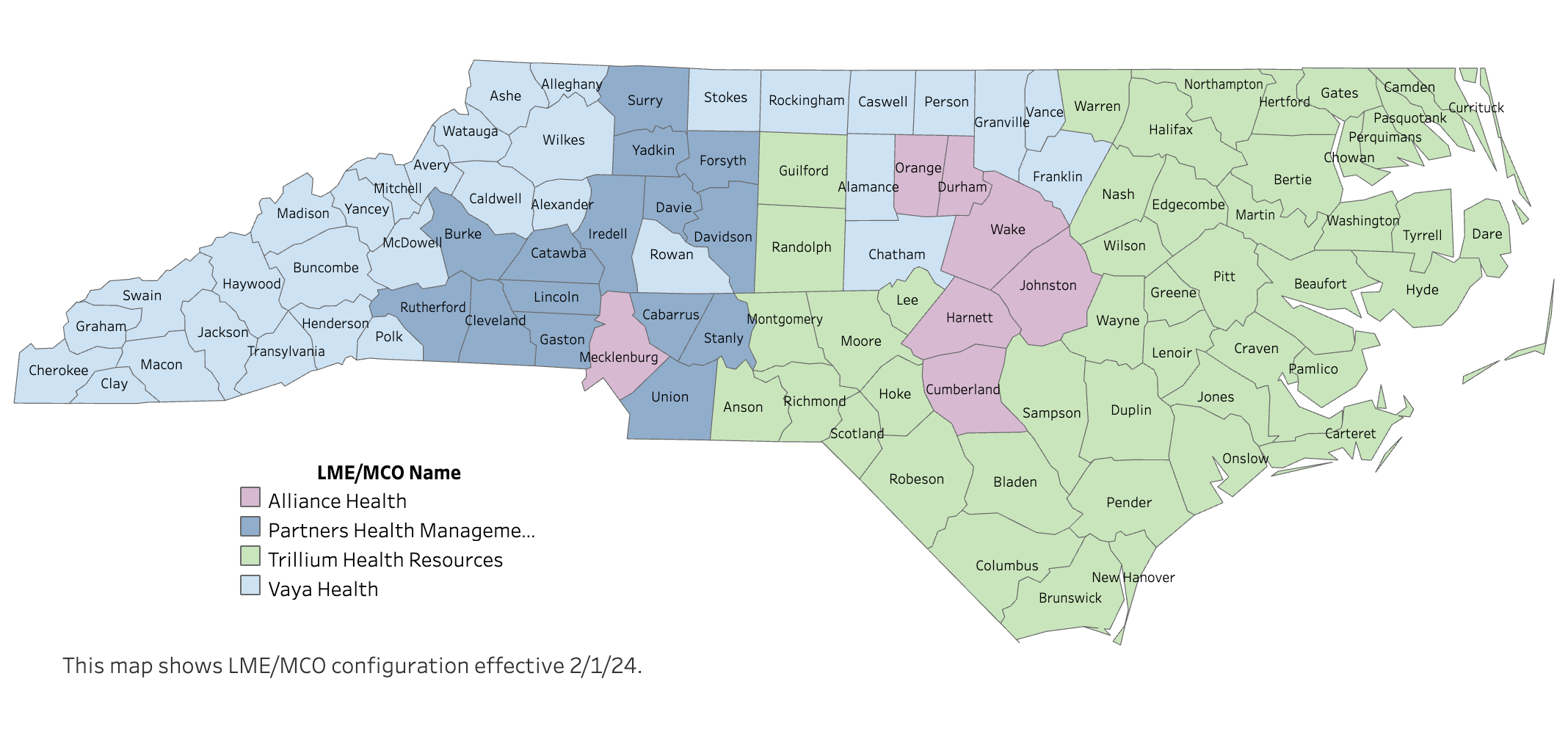
North Carolina has four LME/MCOs (Local Management Entity/Managed Care Organizations) that cover each county. LME/MCOs manage NC Medicaid Tailored Plans, coordinate services for NC Medicaid Direct beneficiaries, and coordinate certain services for EBCI Tribal Option members. See the map below to determine which MCO services your county.
Alliance Health
Counties: Cumberland, Durham, Harnett, Johnston, Mecklenburg, Orange, Wake
Phone: 919-651-8401
Crisis Line: 877-223-4617
Partners Health Management
Counties: Burke, Cabarrus, Catawba, Cleveland, Davie, Davidson, Forsyth, Gaston, Iredell, Lincoln, Rutherford, Stanly, Surry, Union, Yadkin
Phone: 888-235-4673
Crisis Line: 833-353-2093
Trillium Health Resources
Counties: Anson, Beaufort, Bertie, Bladen, Brunswick, Camden, Carteret, Chowan, Columbus, Craven, Currituck, Dare, Duplin, Edgecombe, Gates, Greene, Guilford, Halifax, Hertford, Hoke, Hyde, Jones, Lee, Lenoir, Martin, Montgomery, Moore, Nash, New Hanover, Northampton, Onslow, Pamlico, Pasquotank, Pender, Perquimans, Pitt, Randolph, Richmond, Robeson, Sampson, Scotland, Tyrrell, Warren, Washington, Wayne, Wilson
Phone: 866-998-2597
Crisis Line: 888-302-0738
Vaya Health
Counties: Alamance, Alexander, Alleghany, Ashe, Avery, Buncombe, Caldwell, Caswell, Chatham, Cherokee, Clay, Franklin, Graham, Granville, Haywood, Henderson, Jackson, Macon, Madison, McDowell, Mitchell, Person, Polk, Rockingham, Rowan, Stokes, Swain, Transylvania, Vance, Watauga, Wilkes, Yancey
Phone: 828-225-2785
Crisis Line: 800-849-6127